
Part 1: The culture
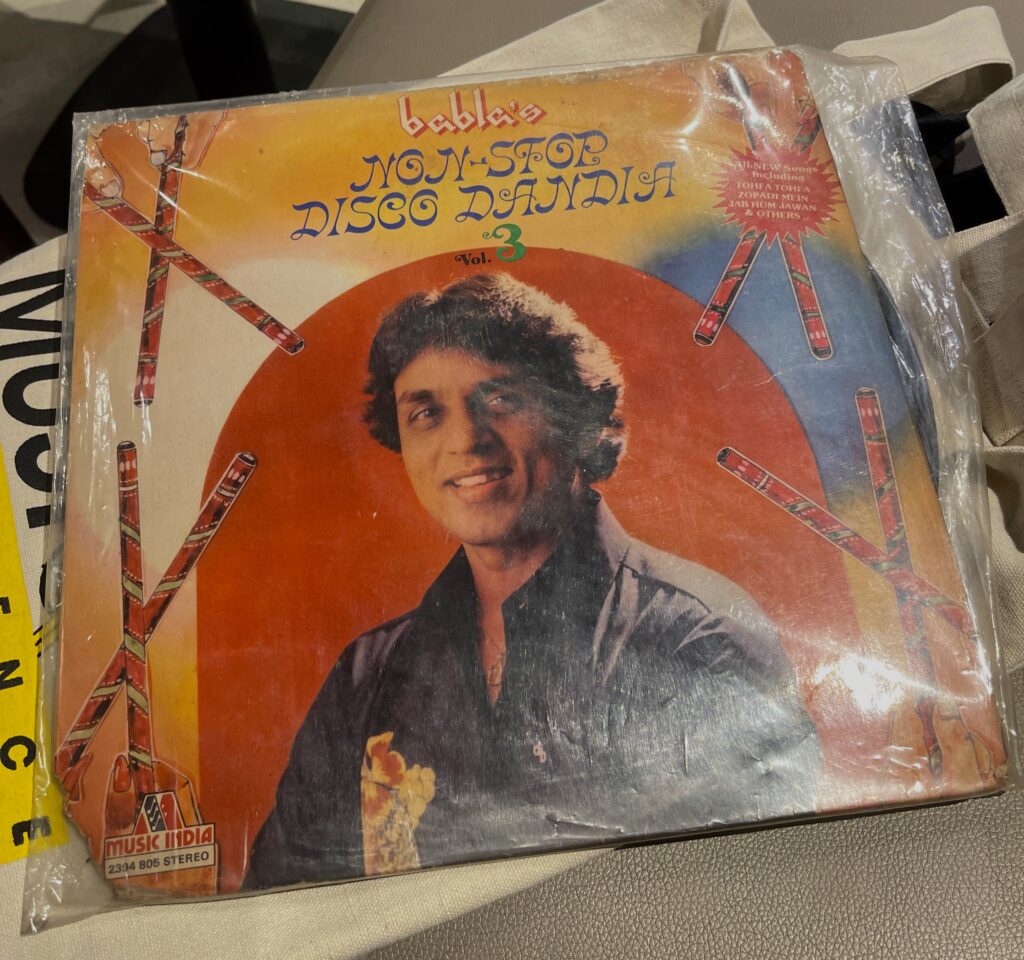
Babla’s Non-Stop Disco Dandia. That’s the name of the record I bought on my first day in Bangalore. Someday, I will play some of it at Frankfurt Airport and see if anyone traveling to the region recognizes it.
My trip to Southern India had been planned months ago, and I had decided to not just be there for the conference I was scheduled to visit, but to get a taste of Bangalore as well. The food alone would be a reason to stay longer, but I knew there would be a lot more.
So, I added something before and after the conference. Three nights in a small bed-and-breakfast in the heart of the city, three nights at the conference hotel near the airport, and two nights at a luxury hotel, the Shangri-La.
The first place was a simple little gem. I arrived at half past two in the morning, and even though I was able to get some sleep on the plane, I dropped into my bed and was gone in seconds.
Six hours later I peeked out of my room, and there was this round table that could easily seat eight but only had a single place mat and plate. I was the only guest that night. My breakfast was as Indian as it gets. A slightly spicy vegetable soup and a couple of white dumplings. Sambar and Idli, as I found out later. Delicious.
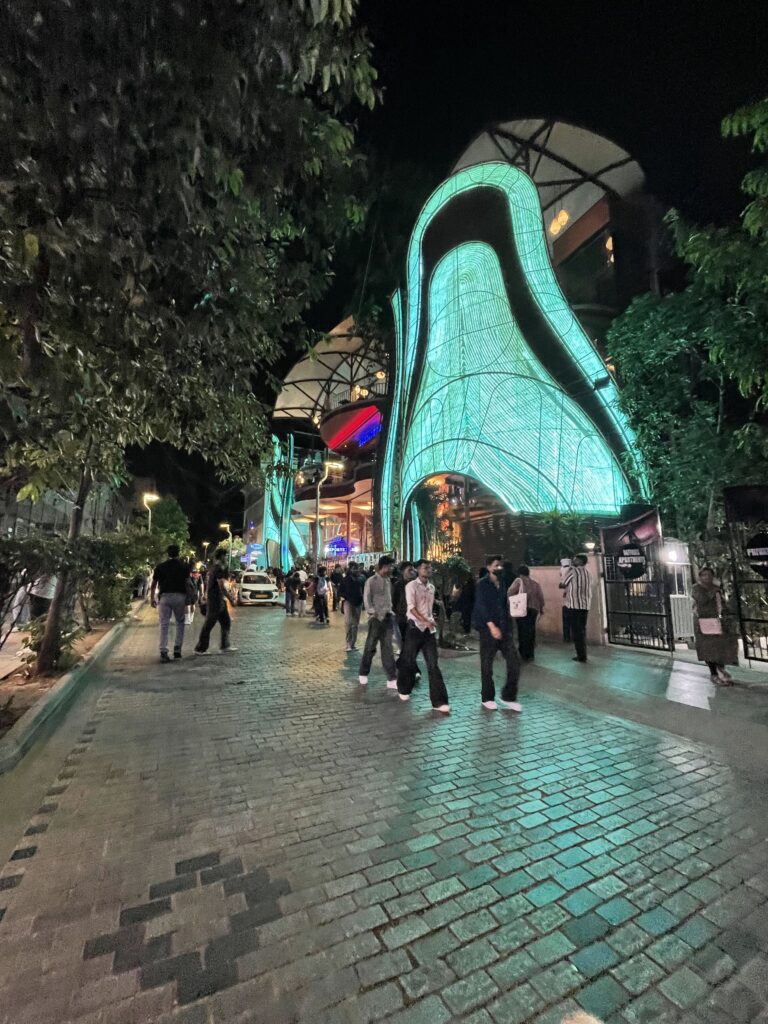
I was ready to start my Bangalore experience. First stop: Church Street. I sat down at Matteo’s, a hip place for coffee and sandwiches. A chair on the wall in the middle of the restaurant so I could watch and listen. Yes, I knew Bangalore is different from other Indian cities (not that I would have seen any others, this was my first day in India), but nevertheless, it’s still slightly surprising to experience it.
Like people talking English. And I don’t mean the fact itself; that’s obviously not a surprise at all. But they talk English with each other, not just with me. Imagine that, if you’re not from an English-speaking country. Two Italians talking English with each other? No way. Totally normal in Bangalore.
The way people dress, here on Church Street. I don’t think I saw a single Saree at the Café. Still a lot of long shirts and bright colours, but no dresses either. And yet, it felt completely authentic. Lots of talking, the place super lively, House music playing – and the Chicken Tikka Sandwich was great.
Mandatory: shopping for vinyl
Up and down the street twice, looking and listening, a photo here and there, and a visit to one of the most fabulous bookstores ever, Blossom Book House. If you ever want to get some inspiration on how to stack books this is where you’ll find plenty. Like putting really long books at the bottom of a stack, one that would reach out of the shelf so far that you can stack books outside the shelf. Blossom is like a Bangalore version of Strand’s, the famous book place in Manhattan. You walk in and you’re lost. Time flies. And you don’t walk out without books. I bought five.
From Church Street it’s just a five-minute walk to Rams Musique. I almost didn’t find it, situated on the second floor of a little mall on MG Road. A friendly saree shop saleswoman helped me, and then I stood in the middle of a lot of vinyl.
I learned quickly that vinyl is a rare thing in India. The prices are steep as everything is either rare or imported. No reason to refrain from extensive crate digging though. Soon enough, I was deep in conversation. About India not having pressing plants anymore, about bands having a hard time being recognized outside of their own country. About why Peter Cat Recording Co. is the one band that has made it to international fame. And of course, about collecting.
It turned out that I was talking to Sangeeth Ram, the son of the famous shop’s founder. Not even 24 hours into my Bangalore experience, I had already made friends with a local. I also bought a record, as you know. Disco Dandia. It’s going to be so much fun to play it.
The choice of restaurant for dinner had already been chosen in the morning. Paragon. A place on Church Street that is known for their fabulous Southern Indian cuisine. Not a fancy place, rather casual and young, run by folks from the Kerala region. I walked over and was lucky enough to get a table immediately. Lots of restaurants have waiting rooms, and the one at Paragon was packed when I left a couple of hours later.
During dinner, there was a young man next to my table who turned out to be from Kerala as well, urgently recommending a houseboat vacation down there. It sounded as great as the food tasted. Two main courses and dessert – I was hungry. The Prawn Mango Curry was so smooth and delicious… And the Chicken Varattiyathu nicely spicy.
While the whole world was watching the football World Cup, the guy next to me was following a cricket match. India was playing England. I said I’d cross my fingers, but apparently, they lost that one.
Needless to say that I slept like a log. And that I didn’t watch the World Cup either.
Diving in: Conversations
The next morning, I was surprised to see that the breakfast table was already filled with a handful of people happily chatting away. They noticed me, wished me a good morning and invited me to the table.
It was an interesting mix of people. A guy with long hair, one that looked like a businessman, one guy somewhere in the middle, and a lady that was clearly on the more modern side of Indian society. I soon found out why this diverse little group seemed so acquainted with each other: they were in town for a class reunion. Pongal, Chai, an omelette, toast and lively conversation made for a great start of the day.
But then it was time for an important visit: Srinivasa Condiment Stores just off Gandhi Bazaar. Wherever I go, I buy herbs and spices. Google said it was open, ChatGPT said it’s open – and of course it wasn’t. An AI classic here: after telling it that the place was closed it said: yes, you’re right, it’s Sunday, they’re not open on Sundays. Good to know, thank you. To be fair though – all other suggestions were absolute winners.
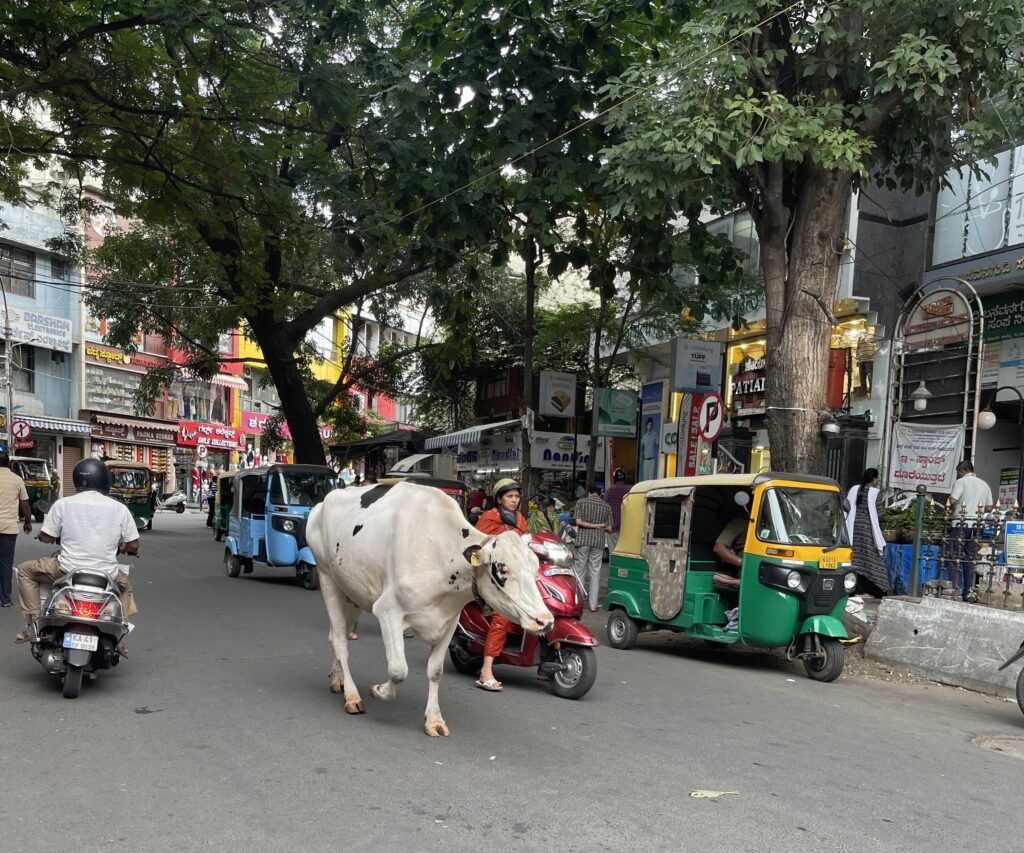
I walked up and down Gandhi Bazaar, watching people, looking at the stands, looking for another opportunity to buy some spices. Oh, and there it was – the first cow on a Bangalore street, happily feeding on leaves that hand dropped from the stands.
For a while I was super worried I had maybe caught one of the bugs that mess with your insides, and I hurried back to the hotel. Fortunately, it was false alarm. Relieved.
Lucky me. After all, I had plans to have early dinner again, at yet another Bangalore legend – Mavalli Tiffin Rooms, or just MTR. The original one, on Lal Bagh Main Road. This time I was asked to join a rather large crowd in the waiting zone.
Surprisingly, it only took about ten minutes, and I was asked to sit a table for four, sharing it with a man and his father. I smiled – the old man had a patch on his vest, something about a hiking club in Berlin. We soon started to chat, and it turned out that he had spent three decades working for Bosch, and that his son had moved to Nairobi long ago, running an IT company. And guess what – he’s a vinyl collector as well.
We had so much to talk about… Buying vinyl in Bangalore (I told him about Sangeeth Ram and my Disco Dandia record), about amps and speakers, about Nairobi (I told him about eating at a place called “Carnivore” back in 1990, and I was surprised to find out that the place still exists), and of course about the food. They had a few suggestions, Rava Idli, Masala Dose and Bisi Bele Bath. I had all three of them, and their famous Filter Coffee.
Time flew, and we enjoyed our conversation and the lovely dishes. In the end I had already decided to invite these wonderful two gentlemen – but they were faster. I was the one who got invited, and I almost hugged them. What a beautiful experience.
From B&B to F&B
Alone again at breakfast next morning, but I was fine with that. So much to reflect upon, and a suitcase to pack as I was going to move to the Taj, a fancy hotel next to the airport. This is where the conference was going to be held. The Airport FAB, about Food & Beverage related topics at airports worldwide.
Waking up in a lovely little B&B, taking an Uber, driving for 70 minutes, being dropped off at one of the largest, finest and most modern hotels in Bangalore – it was a bit of a clash. But again, a lovely reception, getting a Tika on my forehead. And a Tulsi Mala around my neck, a kind of necklace consisting of pieces of branches of a special kind of basil that is considered holy in India.
In the evening, I walked down to get a snack. What I ended up with was an extended journey along about three dozen of dishes at the buffet of the Taj. Oof. Not the MTR kind of experience, but still really good food.
Even here, conversation made a difference, talking to the head waiter about food, spices and coffee. I asked what made Indian Filter Coffee so different, and he said that it’s the 20 percent chicory. It’s always served with milk, usually with sugar, and it’s prepared in a special way, foaming up the milk by pouring it from one cup to another from impressive heights, which is then done again with the coffee to serve it foamy, well mixed and less hot. Good thing I’m still going to be in town for two days after the conference. I need to buy some coffee.
Part 2: The Business
The good shoes, the finer trousers, a dress shirt, a clean shave – it’s like slipping into a different identity. The one that’s on the badge I get at registration. Yesterday I was a culture explorer, today I am a delegate at a conference.
FAB. The world of “airport f&b and hospitality”. A two-day conference plus awards for the finest food and beverage concepts at airports worldwide. Quite a few buzzwords, of course, and a certain amount of repetitiveness. Unavoidable as some topics are more urgent than others. What struck me immediately when I looked at the programme: almost no AI.
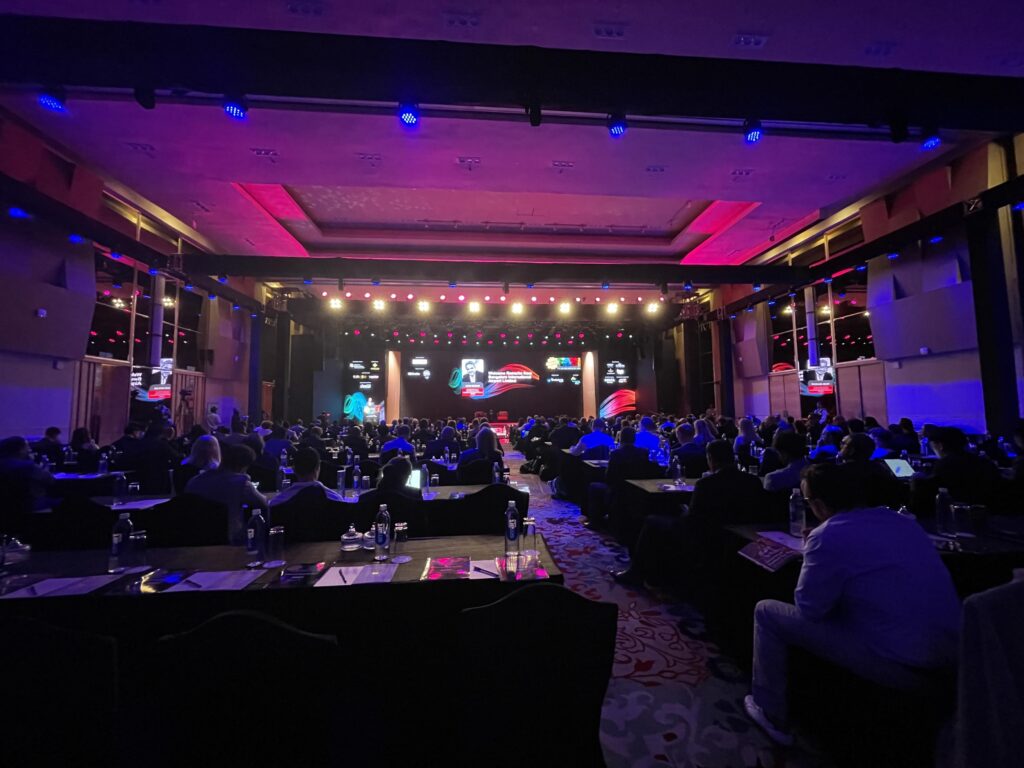
Quite a few times the keynotes talked about the need for authenticity. The only real differentiator, someone even said – as opposed to efficiency in managing the guests at the airport. Positive memories are not created from processes, they come from flavour, from sounds, sights and emotions. What should have been added: from experiences.
This only works if you’re being yourself. Only Frankfurt can be like Frankfurt, only Bangalore like Bangalore. Identity needs to be felt. In several keynotes, this need was translated as “sense of place”, once even as “sense of home”.
But – how do you do that and not run the risk of coming across as provincial, small-town, bourgeois? And: how do you make sure that your authenticity is attractive to those who come from somewhere far away? How do you make sure that someone flying from Bombay to New York and stopping over in Frankfurt quickly understands a German concept as something they should give a try? How do you avoid offering something that only a Belgian knows is typically Belgian and leaves everyone else clueless?
Sometimes, the talk about authenticity clashes with the concepts shown. Louis Vuitton, Lancôme, Fendi, Oreo… Talk about local flavours followed by the face of Gordon Ramsay. I get it – world famous brands and chefs attract customers. But that’s what your local concept is competing with. That’s like a local rock band trying to make it big at Glastonbury. Not impossible, but you really need to make sure you’re convincing.
A key quote: “We have to give people a reason to spend money.” No wonder it comes from a speaker from Doha, an airport that has an even higher share of transit passengers than Frankfurt: 80 percent. Here’s another one: “More and more, it will be about hybrid concepts.” This has been a topic for a couple of years, and it keeps gaining traction.
What’s interesting though: they’re not talking about adding a snack bar to the Duty-Free shop or selling pottery at the Asian restaurant. They talk about places like Lancôme in Doha, where passengers can get beauty treatments, enjoy a glass of champagne, have a rose cake, and of course buy their products.
Here’s another simple truth that relates to this: the passenger is already hybrid; the airports need to think and be hybrid as well. As much as this may be a conference focusing on F&B and not on things people buy – the customer doesn’t differentiate.
By the end of day one we have seen dozens and dozens of images of restaurants at airports, and the talk about uniqueness gets a little blurred. I think of how a passenger is walking through a large airport, looking at a whole range of F&B concepts, trying to make up their minds among all this uniqueness only to head on over to Burger King in the end.
This nicely transitions to another popular concept: “thinking from the consumer”, “looking at what the consumer wants”. But are celebrity-based concepts really what they want?
Here’s an interesting insight about what Gen Z and Millennials really want: up to 45% of these two generations fly to other places saying they are “travelling for food”. They specifically ask for culinary experiences. I sympathize. When I go to Burger King, it’s because nothing else tickled my curiosity.
What immediately lets me forget BK is this wonderful concept: Mitti Café in Bangalore and other Indian airports. All the employees are people with disabilities. These places burst with love and humanity, with a sense of pride and community. Exceptional. Here’s the only real dimension of authenticity, of a sense of place – a place that is very much about India and about topics of Indian society. They are not just selling stuff, they really do something for the people that need it most.
The day ended with drinks and all kinds of fabulous food, courtesy of Bangalore Airport. I could just barely skip the costume part as everyone was invited to decorate themselves the Indian way. Not necessarily my cup of tea – but almost everyone else had their fun with it. Cheers!
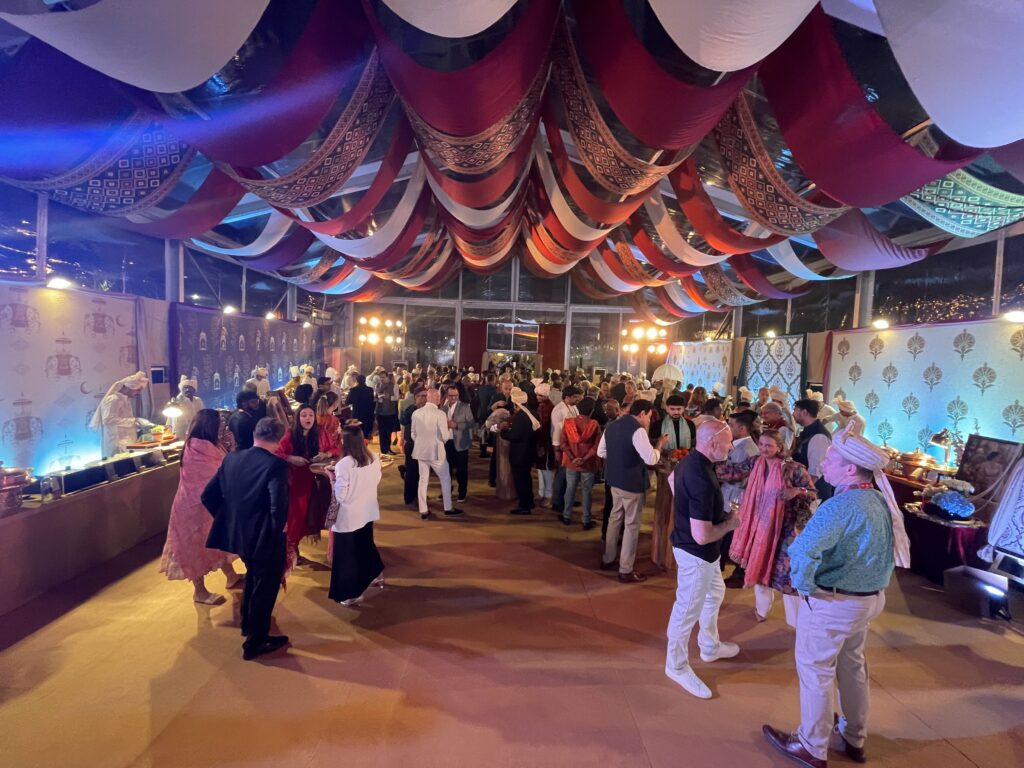
Day Two: Insights and Observations
I skipped one or two sessions on the second day – relatively much talk about lounges, not my focus really. But I could still gather some good insights:
Turning guests into customers: I wondered. Isn’t it just super convenient to simply say “We don’t have passengers, they are guests.” I’m not sure whether folks at many airports really feel like being welcome as guests. Passengers are only guests when they are treated as such. It takes a conscious effort to make that happen. Make sure that people feel as much guest as possible – they might just turn into customers as a consequence.
And again: sense of place. But primarily when the talk centres around design, furniture and decoration. Sometimes there is talk about a need to create memories, but it’s slightly unclear where these memories should come from. It’s too much about spaces and processes, not enough about experiences – and the spaces themselves can only be experiences when they are absolutely outstanding.
Lounge users spend more and interact more. Interesting. 6x more likely to engage, 6x more likely to spend in duty free, 4x more likely to spend overall. Doesn’t connect with our impression (or bias) that they primarily engage with their lounge environment.
Digital connected experiences: Lots of talk about it, and yet – some of the efforts feel like they are trying to find more ways to push for sales rather than support the guest and create a seamless experience. Digital solutions should support the journey and relieve stress, enable guests to spend more of their time at the airport in a relaxed and confident way – which THEN leads to more sales.
Observation: It feels like the often-quoted need for seamlessness is increasingly pushed towards the digital sphere, thinking that an app is able to deliver the necessary coherence and connection. Hardly anyone looks at how they can add to the seamlessness of the physical customer experience in ways that connect to what happens outside of shops and restaurants, namely in the concourse areas.
And we’re not talking about handing slices of Serrano to passengers passing by. That’s not an experience, it’s bait. What is happening on the floor that creates disruption, has stopping power, leads to smiles, ease, even happiness, what is done to open the eyes, the minds, and – consequently – the wallets?
Part 3: The Luxury
What made me smile was that the end of the FAB conference wouldn’t coincide with my departure from Bangalore. Two more days. I was determined to make good use of them. The luxury of the Shangri-La, more shopping and more food.
First of all: filter coffee. After a brief discussion with ChatGPT I decided to check out a place in Jayanagar, Suma Coffee Works. I probably could have gone to at least a dozen other places and gotten equally good products – I guess I just decided by gut feeling.
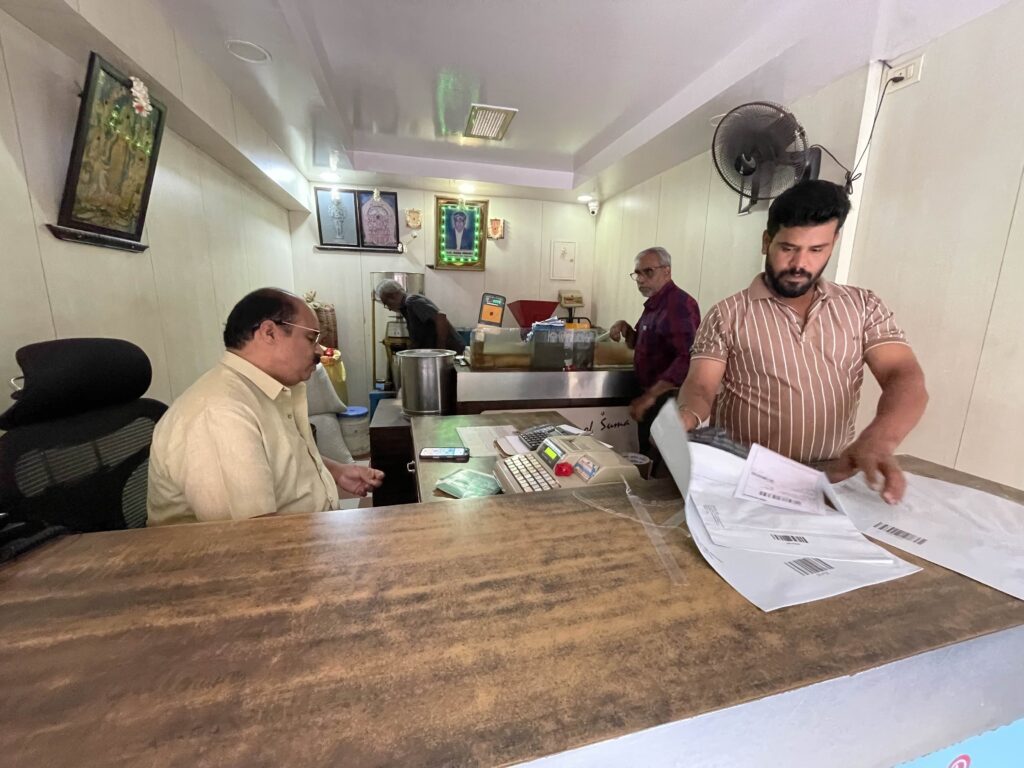
I should have already become accustomed to these kinds of arrivals at recommended shops in Bangalore. I get out of the car, I look around, I see the sign, look at the place, and it’s not much more than a garage-size shop with a couple of guys taking care of business. In the case of Suma, I wasn’t even sure they’d sell a pound to just anyone passing by, it felt more like a small B-to-B kind of establishment.
Shyly, I approached the man at the desk and asked whether I could get two pounds of coffee and he said of course, and what kinds of coffee I would want. Good question. I left it up to him. Suma Special and Peaberry Blend. Not more than 20 percent of chicory he said and asked the guy in the back to prepare my order. Freshly ground and mixed, sealed airtight, ready to be taken to Switzerland. Great.
Too many spices? Naaah.
Looking at the map, I saw that the recommended spice shop was just a good 20-minute walk from Suma, so I chose to stroll on over and see a little more of the neighbourhood. It’s amazing how busy a city can be. Not just on the street. On the sidewalks, in the shops, in the school yards, the alleys, the malls, everywhere.
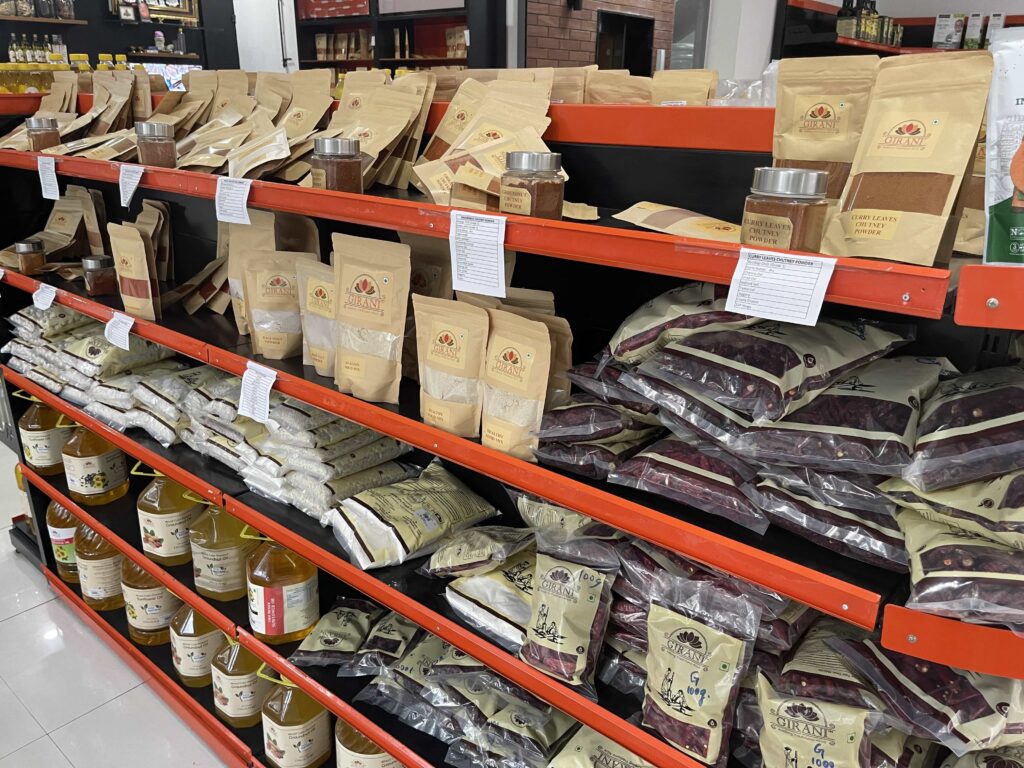
The spice shop was called Girani, and it was pure heaven. I spent at least half an hour there, walking from one spice to another, taking up the fragrance of every single one of them from small cups they keep for sampling, and buying more than a half dozen. Bisi Bele Bath powder, Rasam, Sambar, Kashmiri Chili, even a small bottle of virgin coconut oil. Perfect. I took a look at the other two floors above, where they prepare the virgin oils and keep the spice mill grinding. People go there to have their spice mixes done individually. Can I have a place like that in my hometown please?
For dinner I didn’t need any advice. Long before I had boarded the plane to Bangalore, I had already decided to have dinner at Ssaffron, the fine dining restaurant at the Shangri-La. I couldn’t go wrong there, and I sure didn’t. The amuse bouche already had me speechless. Delhi street food, a multi-layered piece of awesomeness around a chickpea patty, sprinkled with several sauces… I couldn’t believe what I ate.
And I also couldn’t believe how much I ate. I had the generous seafood menu. When I ordered I asked what choices I was expected to make, and they simply said none, I’d get everything that was listed. Oh my. So, so good, so so much, and so impossible to let any of it go back to the kitchen.
It was a rare treat. Including the conversations I had. With Supian, my waiter, with the restaurant manager, and with the chef who even stopped by twice. I had to question him about that street food dish, and about the oil that had been used to prepare the soup. It tasted like the kind of virgin sunflower oil they use in Georgia, and sure enough, that’s what it was.
Surviving chocolate and chicken
On the morning of my last full day, I looked at all the things I had bought, and I began to worry that I might not fit all that in one suitcase. Or that the person at check-in might disapprove of its weight. No more shopping, I told myself. Go to the park, nothing to buy there.
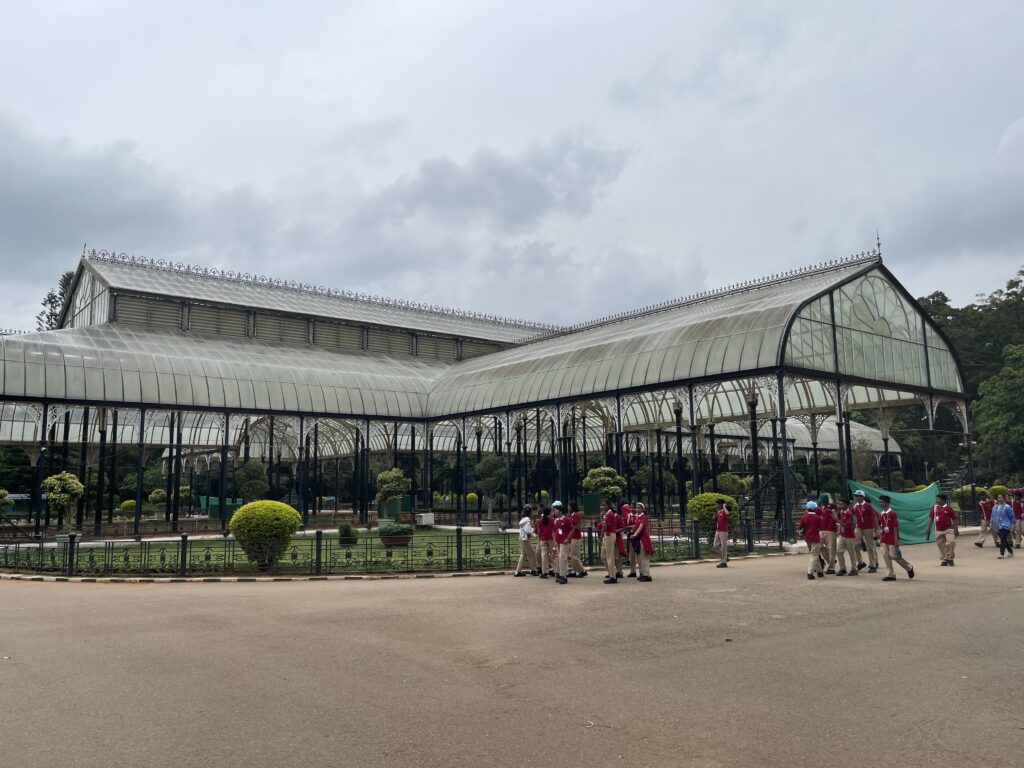
Lalbagh. It’s considerably smaller than Central Park, but it feels twice the size. And once you have made your way into it, you would never suspect that you are in the middle of a city of roughly 14 million people. There’s an impressive Glass House, a three thousand-million-year-old Gneiss Rock with a watchtower on top, and dozens of little gardens. Perfect for starting my last day in Bangalore.
The ideal follow-up: Death by Chocolate. Somewhere I had read that there is this famous ice cream place in Bangalore. Corner House. DBC, as some call it, is their signature dish, and I had to try it.
Once again, a cab released me in front of a nondescript building on a street that looked like any other, and again I was wondering where I was. And where the ice cream place was. I didn’t see it. No shop, no fancy vitrines with dozens of ice cream flavours, nothing. Just a sign on the front of the building. Corner House ice cream – first floor. Oh. Okay. So, I walked up the stairs and sure enough, there it was. Corner House is not a corner house; it’s the first floor of a small office building.
That doesn’t mean they don’t have great ice cream. I’m sure they knew what I would order, and so I did. Death by Chocolate please. Chocolate sponge cake, vanilla ice cream, chocolate sauce, whipped cream, roasted peanuts, and a cherry on top. Oof. That’s plenty. I didn’t die though. I just wondered whether I might need to skip dinner.
But sure enough, a few hours later I was back on the street where I started my week in Bangalore – Church Street. My destination: Bheema, a place that serves Andhra style dishes. The only problem: I was too early; they weren’t open yet.
So, there it went, the promise to avoid further shopping. I took a cab over to Commercial Street, hoping for a place that might sell a traditional davara tumbler set for making filter coffee. Very different neighbourhood. Shops up and down the street, clothing, silk, shoes, cosmetics, jewellery – I just couldn’t find a place that would sell household goods.
It was the only time I got a little stressed out since I arrived in the city. Trying to find something while being approached by beggars and trying to fend off tuktuk drivers and shop owners – not easy. It was prayer time too – three mosques were calling the adhan. No surprise though – Commercial Street is in Shivajinagar, a predominantly Muslim neighbourhood.
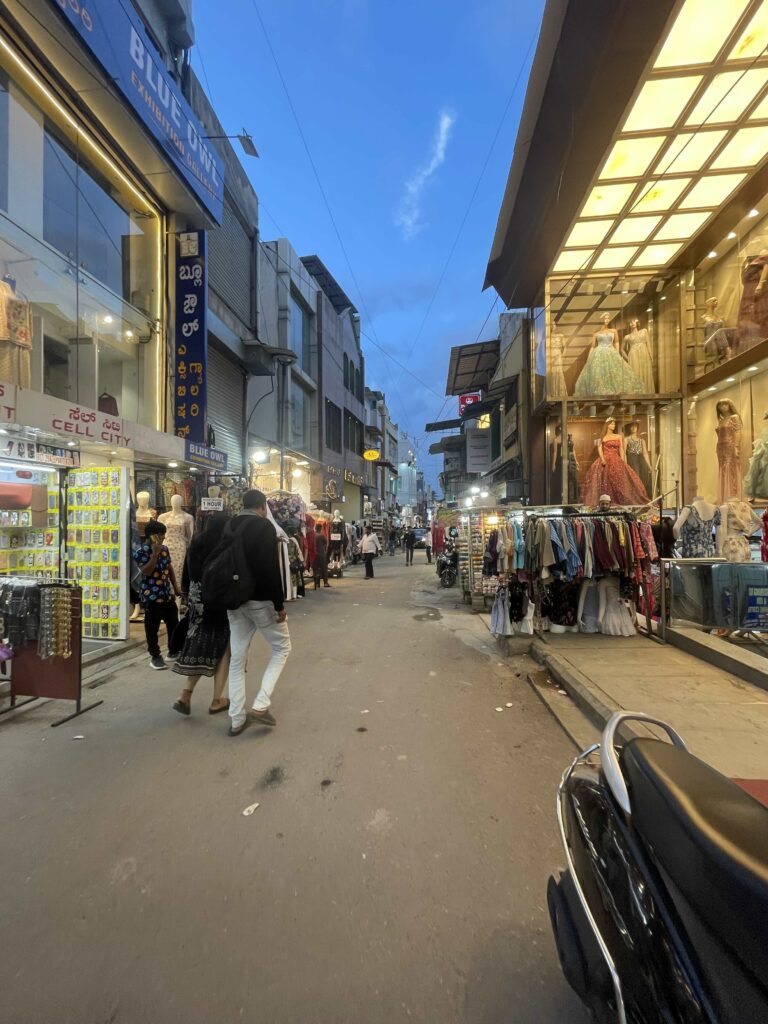
Just when I was about to give up on the cups, I saw it, right at the end of the street: Kitchen World! Perfect. Went right in. First thing I saw: the cups I was looking for. And a gentleman that must have been the owner. While his assistant was placing a selection of different cup designs on a table, the owner proudly told me that they were the oldest shop for household goods in Bangalore. Been there for almost 70 years. Wonderful, I said, I came to the right place.
He asked me something simple and significant though: how are you going to prepare the filter coffee? Good question, I hadn’t thought of it. He showed me what he called a decoction maker. A simple filtering device with two chambers. The upper one for the coffee and the boiling water, the lower one to collect the liquid, the super rich and dense coffee decoction.
Some of these filters are quite large, enabling a family to prepare a rather large quantity of decoction to consume over the course of a day. Yes, of course it cools down, but it is prepared with a lot of very hot milk, and you don’t need all too much of the decoction, as strong as it is.
Needless to say that I bought the decoction maker as well, adding to the already critical weight of my suitcase. Then I was off to add to my own weight, it was past seven so I could return to Bheema’s.
Who needs cutlery?
To my surprise I was the first guest to enter the restaurant, and I was joined by just a handful of other people while I had dinner. Quite a few entered and left again after talking to the waiters. The reason: no seafood available that evening.
Well, I had just enjoyed spectacular seafood the evening before, no problem. Chicken instead. Oh, and another instead: no plates, just a huge banana leaf to eat from with my hands. They gave me cutlery, but it was obvious that this would only be done for tourists.
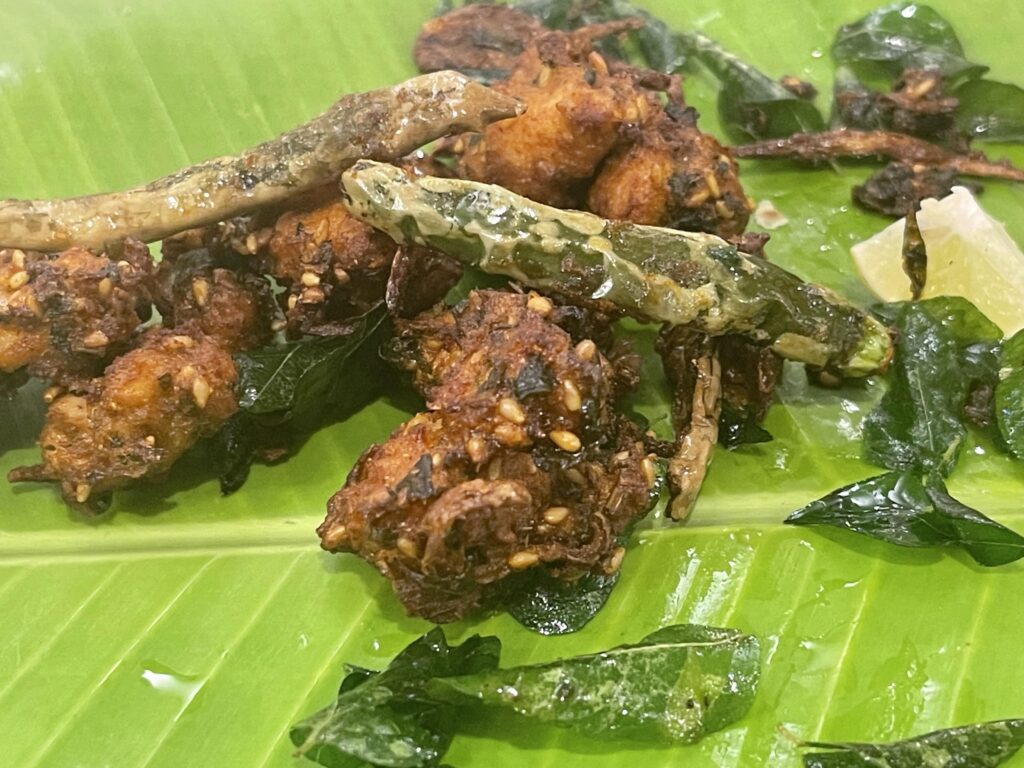
Following my death by chocolate I ordered what then logically qualified as chicken overkill. Two dishes, one of which was declared as an appetizer but would have easily been enough to act as main course (Chicken Bheemas), the other one was called Chicken Pepper Fry Masala, super savoury and bursting with spices. I extinguished the fire with a homemade lemonade. Yes, the water… dangerous… but luckily, no organs were harmed during my stay in India.
No idea why the place was so empty that day. Maybe it was because of a cricket match. The waiters were all huddled around a small TV set, watching their national team play. From the looks of it, the action on the pitch wasn’t particularly exciting. The chicken was, though. Yummy.
Returning to the Shangri-La, I remembered the voucher the receptionist had given me upon arrival, inviting me for a drink at the rooftop bar. Perfect. A gin and tonic or two to close the week and prevent possible death by chicken.
Surprisingly lively place for a luxury hotel. A DJ played some kind of Trance music and groups of people with name tags were cruising the floor. Maybe an expat event. I just sipped my Roku Tonic and watched. Plus, a glass of white wine in exchange for the voucher.
Taking the long way home
My flight back was at 8pm next day. Plenty of time to consider packing options, catch up on some work and get to the airport super early. Arrived around 3pm and tried to get rid of my suitcase quickly. But when I mentioned that I had all my spices in the big bag that I was planning to take along to the cabin they immediately stopped the conveyor belt. Stupid me. No powders of any kind allowed, even if they smell fabulous. I should have known. So I opened the suitcase again and did what I could to add all the bags. No idea how heavy it was in the end, but they accepted it.
Nice people at Bangalore Airport, and competent. No problem checking my luggage through to Zurich even though the flights were on two separate tickets. Very relaxed and convenient check-in in a huge and beautiful hall bursting with tropical plants. There’s even a waterfall, right after security.
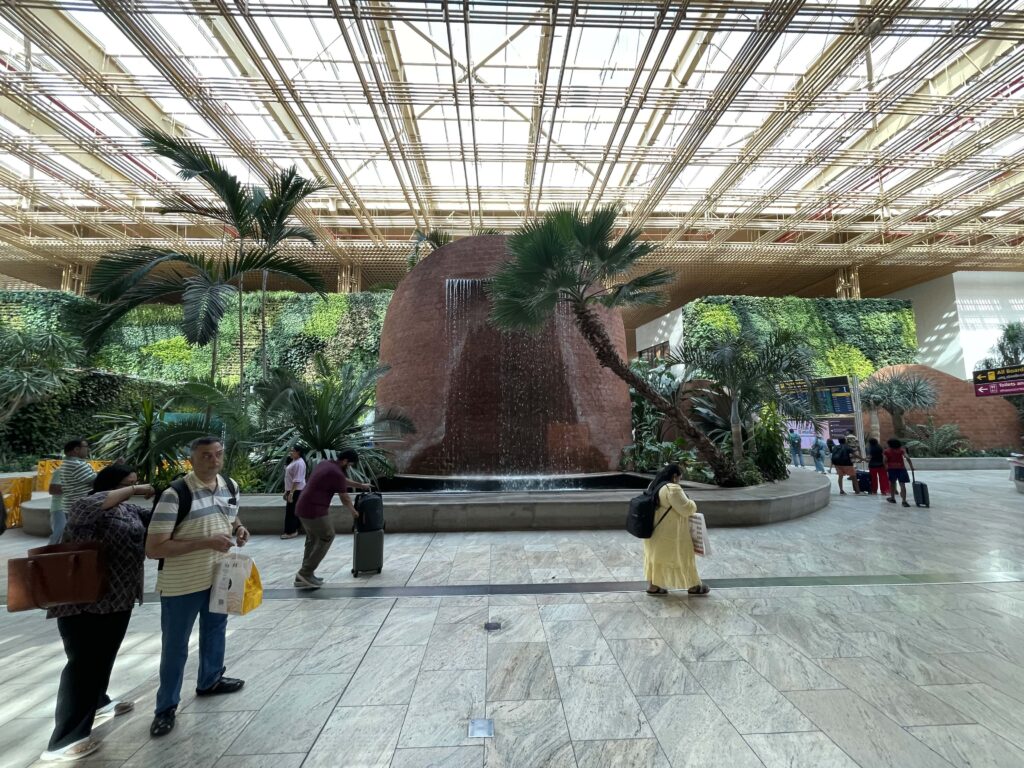
Really nice as well: my FAB conference badge gave me access to Bangalore Airport’s elegant 080 Lounge. Loved it. Everyone is served at their table; the menu is extensive and the food excellent. It sure made saying goodbye to Bangalore a little easier.
So many things will stay with me after this week. Disco Dandiya. Filter Coffee. Spices. Books. And of course – memories, impressions, images, knowledge, connections, and a deep appreciation of a beautiful country.
It might just happen that I will follow the suggestion of the guy at Paragon, fly to Kerala, rent a houseboat and have a beautiful vacation. Get a sense of the place, you might say.